
How much does a single day of site downtime actually cost your project when a skip delivery fails to show up? For site managers across Western Australia, the logistical headache of waste disposal can quickly turn a profitable week into a series of delays. Finding a reliable skip bin for construction waste Perth isn’t just about getting a bin on-site; it’s about ensuring it arrives on time, fits your footprint, and handles the specific weight of building debris without those frustrating hidden costs.
You likely already know that an overflowing or underweight bin can halt a crew’s progress and lead to avoidable safety hazards. We’re here to help you master your site’s waste flow with practical local knowledge and clear compliance tips. This guide will walk you through the essential Marrel bin sizes for heavy rubble, explain the latest metropolitan waste rules, and provide a clear strategy for managing C&D materials efficiently. You’ll learn how to avoid common weight-limit traps and ensure your project stays on schedule and within budget.
Key Takeaways
- Identify exactly what qualifies as Construction and Demolition (C&D) waste to ensure your site remains compliant and avoids unexpected disposal surcharges.
- Learn how to choose the most efficient skip bin for construction waste Perth by matching your project scale to Marrel bin sizes ranging from 2m³ to 10m³.
- Understand the critical weight restrictions for heavy materials like concrete, bricks, and rubble to prevent transport issues and safety hazards.
- Discover the best practices for on-site skip placement and when you might need to check with your local Perth council regarding verge permits.
- Streamline your waste management workflow with practical tips on loading skip bins to maximise space and maintain a tidy, productive building site.
Why Construction Waste Requires Professional Management in Perth
Managing a building site in the Perth metro area involves more than just coordinating trades; it’s about controlling the physical environment. On any project, construction and demolition waste (C&D waste) accumulates faster than most expect. This category of rubbish isn’t like your weekly kerbside collection. It consists of heavy, bulky, and often sharp materials that require specific handling. Using a dedicated skip bin for construction waste Perth allows you to centralise debris, keeping the ground clear for workers and machinery.
Standard household bins simply aren’t built for the structural load of masonry or timber offcuts. They lack the volume and the reinforced construction needed to transport tonnes of debris safely. Professional waste management also directly impacts site safety. A cluttered site increases the risk of trips, falls, and injuries, which can lead to costly delays or safety interventions. By hiring a professional skip service, you create a designated zone for all offcuts and rubble. This keeps the perimeter of the building clear for scaffolding, deliveries, and trade access. For Perth tradespeople, this level of organisation is a hallmark of a well-run site.
The Role of C&D Waste in Sustainable Building
In Western Australia, a large portion of building debris is classified as ‘inert material’. This means the waste doesn’t undergo significant physical, chemical, or biological transformations once disposed of. C&D waste is defined as materials like concrete, bricks, and soil that can be repurposed. When you sort these materials at the source, you often reduce your overall disposal costs. Recyclers in Perth can crush old bricks and concrete into road base or drainage rock, diverting tonnes of material from landfill. Keeping your heavy rubble separate from general site rubbish isn’t just good for the environment; it makes financial sense for your project budget.
Avoiding Site Delays with Reliable Delivery
Site managers know that a full bin is a bottleneck. If your team has nowhere to put debris, the workspace becomes cluttered and progress slows down. Reliable skip bin swap-overs are essential for maintaining a steady workflow. Madi’s Skips understands the local Perth landscape, from the narrow streets of the inner suburbs to the sprawling sites in the outer metro area. We focus on dependable delivery and collection because we know that a delayed skip can throw off an entire day’s schedule. Having a local partner who knows the access requirements of your specific suburb ensures your skip bin for construction waste Perth arrives exactly where you need it, when you need it.
C&D Waste Classifications: What Can You Put in Your Skip?
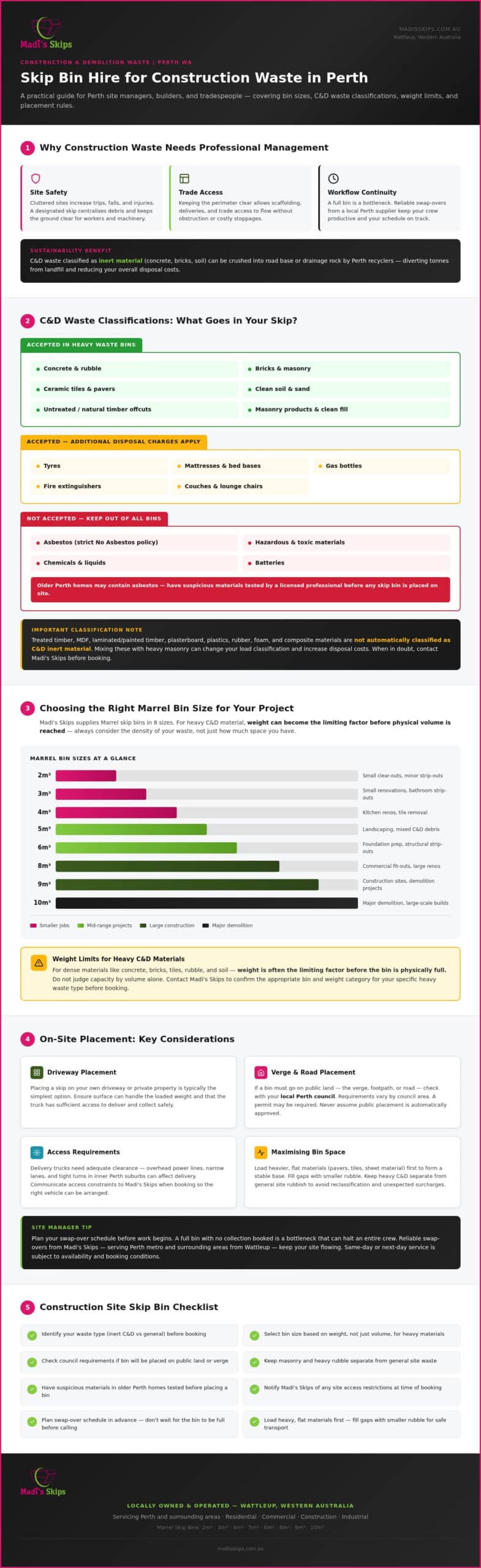
Understanding exactly what goes into your skip bin for construction waste Perth is the best way to avoid project cost blowouts. Not all building debris is processed the same way under Western Australia waste regulations. Waste is generally categorised to ensure that heavy, inert materials are diverted to the right facilities while hazardous items are kept out of the system entirely. Before you start loading, it’s worth distinguishing between ‘Clean Fill’ and mixed construction debris. Clean fill typically refers to pure sand, soil, or clay, whereas mixed C&D includes the various hard materials generated during a strip-out or build. For a broader overview of how to categorise your materials and avoid hidden fees, our complete guide to waste disposal Perth covers everything from bin selection to council rules in one place.
Acceptable Materials for Heavy Waste Bins
Most structural waste from Perth sites is welcome in our heavy waste bins. This includes masonry products such as bricks, pavers, and ceramic tiles, along with concrete and rubble. If you’re preparing a foundation or finishing a landscaping project, clean soil and sand removal is also a standard service. However, timber requires a bit more thought. While untreated pine or natural wood offcuts are usually fine, materials like treated timber, MDF, or laminated boards often fall under general waste categories rather than inert C&D. Mixing these can change the classification of your load, so it’s best to keep your heavy masonry separate where possible.
Some items are accepted but will attract additional disposal charges because they require specialised handling. These include:
- Tyres
- Mattresses and bed bases
- Gas bottles
- Fire extinguishers
- Couches and lounge chairs
Prohibited Items and Hazardous Materials
Madi’s Skips maintains a strict ‘No Asbestos’ policy for every bin we deliver. Asbestos and other hazardous materials pose a significant health risk and cannot be disposed of in a standard skip. If your site involves an older Perth home, you must have any suspicious materials tested before they go near a bin. Beyond asbestos, other strictly prohibited items include liquids like old paint, oils, chemicals, and batteries. These substances can leak during transport and contaminate entire loads of otherwise recyclable brick and concrete. If you’re clearing out a site and aren’t sure if a specific material is allowed, we always recommend asking our team first. If you’re ready to get started with a clear list of what you’re disposing of, you can book a bin online to secure your delivery date.
Choosing the Right Marrel Bin Size for Your Project
Selecting a skip bin for construction waste Perth requires a balance between the physical footprint on-site and the actual volume of debris your crew generates. Madi’s Skips provides Marrel bins ranging from 2m³ to 10m³, ensuring there’s a specific fit for everything from a minor ensuite update to a full-scale property demolition. While volume is the first thing most site managers look at, weight is often the real limiting factor when dealing with heavy materials. Bricks and concrete are incredibly dense. A 10m³ bin filled to the brim with solid concrete would exceed the lifting capacity of most trucks and breach road weight limits.
To help you visualise capacity, each cubic metre is approximately equal to one standard 6×4 box trailer filled to the top rail. This practical comparison makes it easier to estimate your needs before the first hammer swings. Aligning your bin size with your specific project scope is a core part of effective Australian construction and demolition waste management. Getting this right from the start prevents the logistical headache of needing a second bin halfway through a shift.
Small to Medium Bins for Renovations (2m³ – 6m³)
Our 2m³ and 3m³ bins are the go-to choices for bathroom strip-outs or removing small garden walls. They take up minimal space on a driveway or verge, making them perfect for residential projects with tight access. The 4m³ and 5m³ bins represent the ‘sweet spot’ for kitchen renovations and whole-house flooring removals. These sizes provide enough room for cabinetry and tiles without requiring a massive site footprint. If you’re tackling a medium-sized clean-up involving timber waste and mixed debris, the 6m³ bin offers that extra breathing room to keep your site tidy and safe.
Large Bins for Demolition and Major Works (8m³ – 10m³)
When projects scale up, so does the need for high-capacity disposal. Our 8m³ and 9m³ bins are frequently used for light commercial fit-outs and larger residential additions where bulkier items like wall frames and roofing materials are common. For major construction and demolition sites, the 10m³ bin is the heavy-duty workhorse. It’s designed to handle significant volumes of waste, though we always remind customers to monitor the ratio of heavy materials like soil and concrete to stay within safe weight limits. You can check our full range of bin sizes here to find the exact dimensions for your next project. Choosing the right size early prevents the need for multiple bookings and keeps your project moving without unnecessary delays.
Handling Heavy Waste: Weight Restrictions and Site Placement
Positioning your skip bin for construction waste Perth requires more than just a clear patch of ground. You must consider the physics of the lift and the legalities of the location. Heavy materials like concrete, bricks, and sand have strict weight limits because of the mechanical capacity of Marrel lifting systems and Western Australian road safety laws. If a bin is loaded beyond its safe weight capacity, the truck may be unable to lift it, or the load could become a hazard during transit. Site managers should always estimate the density of their waste before the truck arrives to avoid the frustration of a failed collection.
Safe Loading for Heavy Materials
Loading a skip correctly is essential for site safety and logistical efficiency. You must keep the waste level with the top rim of the bin at all times. Items protruding above the rim make the load unsafe for transport and can result in heavy fines for the driver. To ensure a safe lift, distribute heavy debris like masonry and rubble evenly across the floor of the bin. Piling all the weight in one corner can cause the bin to tilt or shift during the lifting process. Overfilling is a common mistake that leads to site delays, as drivers are legally prohibited from transporting bins that pose a risk to other road users.
Perth Council Permits and Verge Placement
Where you place your bin depends on your site layout and the rules of your local government area. If you intend to place a skip on the verge or a public road, you will likely need to check with your local council. Requirements vary significantly between the City of Perth, City of Melville, or City of Stirling, so it is vital to confirm their specific permit rules before your delivery date. While placing a bin on a private driveway is often the most convenient choice, you should take steps to protect your property. Heavy skips can crack pavers or leave marks on decorative concrete. We recommend placing timber planks down first to distribute the pressure. Additionally, ensure the truck has at least 3 metres of width and 4 metres of height clearance to navigate your site safely without hitting eaves, fences, or overhead power lines.
Choosing a reliable skip bin for construction waste Perth means working with a team that understands these local constraints. By planning your site placement and loading strategy in advance, you keep your project moving and avoid the unnecessary costs associated with overfilled bins or damaged driveways.
Why Perth Builders Trust Madi’s Skips for Construction Waste
Reliability is the currency of the Western Australian construction industry. If a skip isn’t there when the demolition crew arrives, or isn’t collected before the next trade is scheduled to start, the financial impact ripples through the whole project. Madi’s Skips has built a reputation among local builders by prioritising these logistical details. As a locally owned and operated business based in Wattleup, we focus on straightforward service that keeps your site moving. We don’t hide behind corporate layers; we provide the direct, dependable support that busy site managers need to stay on track. When you hire a skip bin for construction waste Perth from us, you’re partnering with a team that values your project’s timeline as much as you do.
Local Knowledge and Reliable Service
Our Wattleup base is strategically located to provide efficient coverage across the entire Perth metropolitan area. This local footprint means we understand the specific access challenges of different suburbs, whether you’re working on a tight residential block in the inner city or a sprawling industrial site. Dealing with a family-owned business offers a level of accountability you won’t find with national waste conglomerates. You aren’t just another account number to us; you’re a local partner.
When you call us for a skip bin for construction waste Perth, you speak to someone who understands the local industry. There are no corporate call centres or automated queues. We offer practical advice on bin sizes and waste types based on real-world experience on Perth building sites. This direct communication ensures that your specific site requirements are understood and met every time. We offer competitive pricing for commercial and industrial skip bin hire, providing professional-grade waste management without the unnecessary complexity of larger firms.
Ready to Book Your Construction Skip?
We’ve streamlined our booking process to suit busy professionals who don’t have time for lengthy administrative tasks. Our online system allows you to select your suburb, choose your waste type, and pick the perfect Marrel bin size in just a few clicks. This transparency ensures you get an accurate quote based on your specific location and debris type, helping you maintain strict control over your project budget. Whether you need a 2m³ bin for a quick strip-out or a 10m³ bin for a major demolition project, our fleet is ready to assist. If your project has unique requirements or you’re dealing with a complex waste stream, we’re always available to provide a tailored solution.
Contact Madi’s Skips for expert advice on your project
Streamline Your Site Logistics for a Productive Build
Managing a productive building site requires constant attention to detail, particularly regarding the heavy rubble and debris that accumulates daily. By selecting the right Marrel bin size from our 2m³ to 10m³ range and understanding the specific weight limits for materials like concrete and bricks, you keep your project moving without unnecessary bottlenecks. Our locally owned team based in Wattleup brings specialist C&D waste knowledge to every delivery, helping you navigate local council rules and site access requirements with ease.
Securing a reliable skip bin for construction waste Perth is a small logistical step that makes a massive difference to your site’s daily workflow and safety. You now have the practical tools to classify your waste correctly and load your bin safely, ensuring a smooth collection and a consistently tidy workspace. We’re ready to help you handle the heavy lifting so you can focus on the build itself.
Our straightforward booking system and dependable local service ensure your waste management is one less thing to worry about. We look forward to supporting your next project with the right equipment and expert local advice.
Frequently Asked Questions
What is considered construction and demolition (C&D) waste in Perth?
C&D waste primarily includes heavy, inert materials generated during building or demolition work. In the Perth metro area, this typically covers concrete, bricks, pavers, ceramic tiles, sand, and rubble. These materials are often processed for recycling into road base. While other building materials like timber or plastics are part of the site’s rubbish, they are often classified differently depending on the specific facility’s rules and the proportion of heavy material in the load.
Can I put bricks and concrete in a general waste skip bin?
You can place bricks and concrete in a general waste skip, but you must be mindful of the weight restrictions. Heavy materials like masonry quickly reach the lifting capacity of the truck before the bin is physically full. For projects involving large amounts of rubble, it’s often more cost-effective to book a skip bin for construction waste Perth specifically. This ensures the waste is handled according to its classification and helps you avoid overfilling surcharges.
Do I need a council permit to put a skip bin on the verge in Perth?
Permit requirements for verge placement depend entirely on your local council’s regulations. Councils such as the City of Perth, Melville, or Stirling have different rules regarding how long a bin can stay on a public verge and whether a fee applies. It’s essential to check with your specific local government authority before your delivery date. If the bin is placed on private property, such as a driveway, a council permit is generally not required.
What size skip bin do I need for a bathroom renovation?
For a standard bathroom renovation, a 2m³ or 3m³ Marrel skip bin is usually the most appropriate choice. These sizes comfortably accommodate the removal of tiles, old vanities, and shower screens without taking up excessive space on your site. If your project involves knocking down walls or removing a large amount of heavy floor bedding, you might consider stepping up to a 4m³ bin to ensure you have enough capacity for the extra weight and volume.
Are there weight limits for skip bins filled with soil or rubble?
Yes, every skip bin has a weight limit based on the lifting capacity of the Marrel truck and Western Australian road safety laws. Soil, sand, and rubble are extremely dense, meaning a bin can become too heavy to lift even if it isn’t full to the top. When disposing of these materials, it’s vital to keep the load level with the rim and discuss your specific requirements with us to ensure we provide a bin suited for heavy waste.
Is asbestos allowed in any Madi’s Skips bins?
No, asbestos is strictly prohibited in all Madi’s Skips bins. We do not offer asbestos disposal or hazardous chemical removal services. Placing asbestos in a standard skip bin poses a significant health risk to our team and the public, and it can lead to substantial fines and decontamination costs. If you suspect your site contains asbestos, you must engage a licensed specialist removalist to handle and dispose of the material according to safety regulations.
How much notice is required for skip bin delivery in the Perth metro area?
We recommend booking at least 24 to 48 hours in advance to guarantee your preferred delivery time. While we strive to offer same-day or next-day service across the Perth metro area, this is always subject to bin availability and our current booking schedule. During peak construction periods, providing more notice ensures your site workflow isn’t interrupted. You can check current availability and get an instant quote through our online booking system at any time.
Can I put timber and metal in the same construction skip?
Yes, you can typically mix timber and metal within a construction skip, provided the load doesn’t contain prohibited hazardous materials. This is common during site clean-ups or renovations where various building materials are discarded at once. However, if your bin is primarily for heavy materials like concrete or bricks, adding large amounts of timber may change the waste classification. It’s always best to clarify your waste mix when booking to ensure you receive the most cost-effective waste disposal Perth rate.
Disclaimer
The information provided in this article is general in nature and is intended as a guide only. While Madi’s Skips aims to provide accurate and up-to-date information, skip bin availability, pricing, service areas, waste classifications, disposal requirements, weight limits, surcharges and other conditions may change and can vary depending on the type and quantity of waste, bin size, delivery location and disposal facility requirements.
Information in this article should not override Madi’s Skips’ current Terms & Conditions, booking conditions or the information provided during the online quoting and booking process. Where there is any inconsistency, the current Terms & Conditions and booking information applicable at the time of hire take precedence.
Waste acceptance and classification can depend on the materials contained within a load. If you are unsure whether a particular material can be placed in a skip bin or which waste type you should select, please contact Madi’s Skips before booking or placing the material in the bin.
Any information relating to council permits, regulations or requirements is general guidance only. Requirements may vary between local government areas and can change over time. Customers are responsible for confirming any applicable requirements with their relevant local authority.
Madi’s Skips accepts no responsibility for loss, additional charges or other consequences arising from reliance solely on general information contained in our blog without confirming the requirements applicable to your individual booking.
