
What if the bin that looks just big enough leaves you needing another one? Choosing between rubbish skip sizes by eye alone can mean hiring a bin that is too small for the clean-up or paying for more capacity than you need.
If cubic metres are hard to picture, you’re not alone. This guide turns the measurements into practical examples so you can compare Madi’s Skips’ Marrel bins from 2m³ to 10m³ with the rubbish your project is likely to produce. Use the examples as a starting point for a household clean-up, renovation or larger site job, not as a guarantee of what will fit.
The type of waste matters as much as the space it takes up. Soil, bricks and concrete can reach weight limits before a bin looks full, while Perth placement and loading requirements can affect your plans. With a clearer way to visualise volume and a few key checks, you can choose with more confidence and avoid common sizing surprises.
Key Takeaways
- Picture a cubic metre in practical terms, including how a standard 6×4 box trailer can help you estimate a load.
- Compare Madi’s Skips’ rubbish skip sizes, from 2m³ to 10m³, to find a starting point for your clean-up or renovation.
- Use your project type to narrow down a suitable bin, then allow for variations in waste volume.
- Check the waste category before booking, especially for soil, bricks, concrete and other heavy materials.
- Consider how you will load the bin and organise skip bin hire across metropolitan Perth.
Visualising Volume: Understanding Cubic Metres for Your Perth Project
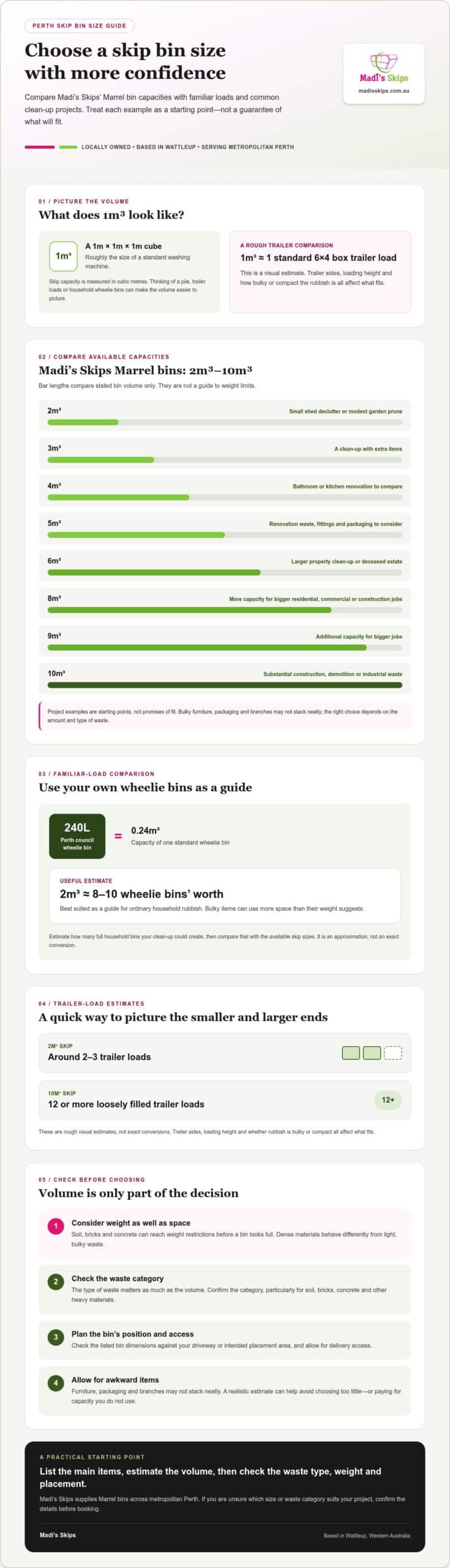
Skip bin capacity is measured in cubic metres, but you don’t need to calculate dimensions to estimate your clean-up. Picture the rubbish as a pile and consider how many trailer loads or household wheelie bins it might fill. These comparisons offer a practical starting point when comparing rubbish skip sizes, although the shape and density of your waste affect how it packs.
A cubic metre (m³) is a 1m x 1m x 1m cube, roughly the size of a standard washing machine. For a more detailed explanation, see this guide to understanding cubic metres.
The 6×4 Trailer Comparison
As a rough guide, 1m³ is similar to one standard 6×4 box trailer load. On that basis, a 2m³ skip is around 2–3 trailer loads, while a 10m³ skip may hold the equivalent of 12 or more loosely filled trailer loads. These are visual estimates, not exact conversions. Trailer sides, loading height and whether the rubbish is bulky or compact all affect what fits. Still, picturing the number of trips can make a skip’s capacity easier to judge than a cubic-metre figure alone.
Wheelie Bin Equivalents
A standard 240L Perth council wheelie bin holds 0.24m³, so a 2m³ skip is approximately 8–10 wheelie bins’ worth of waste. Use your own bins as a guide: estimate how many full bins your clean-up would create, then compare that total with the available skip sizes. This works best for ordinary household rubbish. Bulky items may take up more room than their weight suggests, while compact or heavy materials behave differently.
Choosing a bin with enough room can help you avoid arranging another hire because the first one filled too quickly. A much larger bin than the job needs, however, may mean paying for unused capacity. Make a realistic estimate and allow for awkward furniture, packaging or branches that do not stack neatly. The right choice depends on both volume and waste type, since heavy materials can reach weight restrictions before the bin looks full.
Madi’s Skips is locally owned and based in Wattleup, supplying Marrel bins across metropolitan Perth. Learn more about Madi’s Skips’ Perth skip bin service, then use these comparisons as a first step towards matching your clean-up to an available size.
A Detailed Breakdown of Madi’s Skips Bin Sizes (2m³ to 10m³)
Madi’s Skips offers Marrel bins in 2m³, 3m³, 4m³, 5m³, 6m³, 8m³, 9m³ and 10m³ sizes. The right size depends on the amount and type of waste, how bulky it is and where the bin will go. Treat project examples as a starting point, not a guarantee. Heavy materials may reach weight restrictions before the bin is full.
Residential Favourites: 2m³ to 5m³
A 2m³ bin may suit a small shed declutter or modest garden prune. A 3m³ option gives you more capacity for a clean-up with extra items. For bathroom or kitchen renovations, compare 4m³ and 5m³ bins, allowing for removed fittings, packaging and other project waste. These sizes can also be useful when clearing unwanted belongings before or after a move.
To narrow down your choice, list the main items and consider which ones will be awkward to stack. Check that the waste is suitable for the bin you’re booking, particularly if the project will produce mixed materials. Madi’s Skips’ skip bin sizes and dimensions can help you compare the available options and plan where a bin could sit on your property.
Large Project Bins: 6m³ to 10m³
A 6m³ bin may suit a larger property clean-up or deceased estate, depending on the volume and contents. The 8m³ and 9m³ options offer additional capacity for bigger residential, commercial or construction jobs. For substantial construction, demolition or industrial waste, a 10m³ bin provides more room. It can be useful for light, bulky materials such as timber and furniture, but it isn’t automatically suitable for dense loads.
Capacity alone does not tell you whether a bin will fit in your available space. Check the listed dimensions against your driveway or intended placement area, and allow for delivery access. If you’re unsure which size or waste category suits your project, confirm the details with Madi’s Skips before booking.
Matching Rubbish Skip Sizes to Common Perth Projects
The same-sized pile can call for different bins depending on what it contains. A sofa is bulky but relatively light, while soil or broken tiles may take up less space and become heavy quickly. Use these project examples to narrow down the rubbish skip sizes worth considering, then check the waste type and any weight limits before booking.
- Spring clean or decluttering: A 3m³ or 4m³ bin may suit a clear-out involving unwanted household items, boxes and general rubbish. Choose based on the number of rooms and bulky pieces, not just the number of bags.
- Moving house: Allow for more than the visible pile. Clearing cupboards, the shed and storage areas can add packaging and unwanted belongings. Make a rough list before selecting a size.
The Renovation Rule of Thumb
A 4m³ bin may be a starting point for a bathroom renovation, but tiles, a vanity, a bath and other removed materials vary in size and weight. Don’t assume the full load will fit or that every material belongs in the same waste category. Kitchen work can produce more bulky cabinetry, so compare 5m³ and 6m³ options as a starting estimate. For more project-based guidance, read What Size Skip Bin Do I Need? Perth Bin Selection Guide (2026). Confirm uncertain waste types with Madi’s Skips before booking.
Garden Blitz and Outdoor Clean-ups
Leaves, lawn clippings and small branches are light but can fill a bin quickly because they’re loose and awkward to compact. Stumps and logs are denser, so weight may become a concern sooner. Soil and sand can look modest in volume while adding considerable weight. A smaller 2m³ or 3m³ bin may be a sensible option to discuss for soil removal, but that does not guarantee the load will meet weight limits. Check the suitable waste category and limits with Madi’s Skips before loading.
Turf can combine bulky vegetation with heavy soil attached to the roots. Estimate green waste separately from soil or turf rather than judging everything as one pile. If the clean-up includes mixed materials, ask whether they can go together in the selected bin.
These examples are starting points, not fixed project-to-bin rules. The amount of waste, material density and how neatly items can be loaded all affect the final fit. Check Madi’s Skips’ available skip bin sizes, then confirm the waste type and bin choice if your project includes heavy or mixed loads.
Beyond Volume: Weight Restrictions and Loading Your Skip Correctly
A skip can look only partly full and still be heavy. Bricks, concrete, soil, sand and rubble are dense, so weight can become a limiting factor before the bin’s volume is used. Light, bulky waste such as furniture takes up more room for its weight. When comparing rubbish skip sizes, consider both the space your waste needs and its likely weight.
A 10m³ bin offers more volume, but that doesn’t mean it can be filled with 10m³ of solid concrete. Volume and allowable load weight are different things, and weight limits depend on the bin and waste type. Before booking for a heavy load, tell Madi’s Skips which materials you plan to dispose of and confirm the applicable requirements.
Construction and Demolition (C&D) Waste Rules
Bricks, tiles, sand and rubble may qualify as C&D or inert waste under Madi’s Skips’ current waste rules. Don’t assume every material from a building or renovation project belongs in the same category. Some materials, including plasterboard and processed timber, may have different requirements.
If your load contains both heavy rubble and general rubbish, check its classification with Madi’s Skips before booking. Don’t assume the materials can be combined under one waste category or that the same limits apply. Describe each material clearly and confirm any applicable requirements or charges. If you’re unsure whether your load qualifies as C&D waste, ask before placing anything in the bin.
How to Pack Your Skip Correctly
Plan the load before you start. Break down furniture where practical, and place flat items such as doors or timber low in the bin to create a stable base. Add smaller debris to suitable gaps to use the space efficiently, and distribute heavy materials instead of concentrating them in one area. Better packing can reduce wasted space, but it does not change the weight limit.
Keep rubbish level with, or below, the rim. Don’t use “greedy boards” or stack waste above the sides. An overfilled skip can be unsafe to transport and may not be suitable for collection. If the bin reaches the rim before the job is done, stop and contact Madi’s Skips to discuss the next step instead of adding more material.
Before loading, confirm the correct waste category and applicable weight requirements, particularly for soil, bricks, concrete and mixed materials. This helps you choose a suitable bin and load it with fewer surprises. Madi’s Skips does not accept asbestos or hazardous chemicals.
How to Organise Your Skip Bin Hire in Perth with Madi’s Skips
Madi’s Skips is locally owned and based in Wattleup, servicing residential, commercial and industrial customers across metropolitan Perth. Start by checking that your suburb is within the current service area, then choose a bin size and waste type to match your project. The online booking system can help you get an instant quote based on your details.
Check Your Suburb and Delivery Access
Service availability can depend on your delivery location, so check the Perth skip bin service areas before booking. If you’re considering same-day or next-day service, contact Madi’s Skips to check availability and applicable booking conditions rather than assuming a particular delivery date.
Before choosing a placement spot, consider the delivery vehicle’s access and the space needed for the bin. Tell Madi’s Skips about narrow driveways, low branches, gates, sloping ground or other potential obstacles. If you plan to place the bin on a verge, road, footpath or other public land, check requirements with your local council before ordering. Rules can vary between councils, and you may need to organise any required approval.
Confirm the Details Before You Book
Use the online system to enter your suburb, select an available size and provide the requested waste information for an accurate quote. Madi’s Skips offers Marrel bins from 2m³ to 10m³, but the right choice depends on the amount and type of rubbish, as well as any weight restrictions. Don’t choose on capacity alone if your load includes heavy materials such as soil, bricks or concrete.
Before you confirm, run through this checklist:
- Project waste: List the main materials and confirm the correct waste category.
- Bin size: Compare your estimated volume with the available rubbish skip sizes, allowing for bulky items and heavy loads.
- Placement: Check the driveway or chosen site for access and enough room for delivery.
- Unusual items: Ask Madi’s Skips about items such as tyres or mattresses before including them, as additional disposal charges may apply.
Clear details help you avoid booking a bin that’s unsuitable for the waste or difficult to place at your property. If you’re uncertain about an item or the size you need, contact Madi’s Skips before completing your booking.
Choose Your Bin with Confidence
The right bin depends on more than the apparent size of the rubbish pile. Use cubic-metre and trailer comparisons to estimate volume, then consider whether bulky items or dense materials will affect how much fits. For soil, bricks, concrete and other heavy waste, check the waste category and weight requirements before booking.
Madi’s Skips’ Marrel range from 2m³ to 10m³ offers options for projects from a household clean-up to a larger commercial job. Madi’s Skips is locally owned and operated in Wattleup, with delivery and collection across metropolitan Perth. Check access, placement and waste type before choosing between rubbish skip sizes.
Ready to organise your clean-up? Get an instant quote based on your project details and book online.
With a considered size choice and the right waste information, you can get your project underway with greater confidence.
Frequently Asked Questions
What is the most popular skip bin size for a house clean-out in Perth?
There isn’t one skip bin size that suits every Perth house clean-out. A 3m³ or 4m³ bin may be a useful starting point for general decluttering, but the right capacity depends on how many rooms you’re clearing and whether you have bulky furniture. Estimate the load before booking, and remember that waste type and weight matter too. Madi’s Skips offers Marrel bins from 2m³ to 10m³.
Can I hire a 10m³ skip bin for concrete and brick disposal?
A 10m³ bin may not suit a full load of concrete or bricks because these dense materials can reach weight restrictions before the bin is full. Bin capacity by volume doesn’t indicate how much heavy waste can be safely loaded. Tell Madi’s Skips what materials you have and how much before booking. Bricks and concrete may qualify as C&D or inert waste under current waste rules, so confirm the correct category.
How many trailer loads fit into a 4m³ skip bin?
As a rough visual estimate, a 4m³ skip holds about four standard 6×4 box-trailer loads. Treat this as a guide, not an exact conversion. Trailer sides, loading height and whether items stack neatly all affect capacity. Bulky furniture may take up more room than compact rubbish. For a more useful estimate, picture the actual items you’re clearing and allow for awkward shapes and gaps.
Will a 6m³ skip bin fit on a standard Perth driveway?
You can’t tell from capacity alone whether a 6m³ bin will fit your driveway. Check the bin’s external dimensions and compare them with the usable space, allowing for access and obstacles such as gates, trees or parked vehicles. Madi’s Skips provides size information to help you plan. If the proposed placement is on a verge or other public land, check your local council’s requirements before booking.
What happens if I overfill my skip bin above the rim?
Keep rubbish level with or below the rim. Waste stacked above the sides can make a skip unsafe to transport and may prevent safe collection. Don’t add “greedy boards” or pile on extra material once the bin is full. If you run out of room, pause and contact Madi’s Skips to discuss your options instead of forcing more rubbish into the load.
Are there weight limits for the different rubbish skip sizes?
Yes, weight restrictions apply, and the suitable limit depends on the bin and waste type. Soil, sand, concrete and bricks are much denser than household rubbish, so a bin can reach its weight limit while still looking partly empty. Exact limits aren’t listed here, so confirm them with Madi’s Skips before booking heavy waste. This check matters just as much as comparing rubbish skip sizes by volume.
Do I need a council permit for a skip bin on my verge in Perth?
Check with your local council before placing a skip bin on a verge, road or footpath. Requirements and application processes can vary between Perth councils, and public-land placement may require approval. A bin placed entirely on private property is different, but check council guidance if you’re unsure where the property boundary sits. Confirm placement requirements before booking so you can plan the location and timing appropriately.
Can I put old mattresses or tyres in any size skip bin?
Don’t assume mattresses or tyres can go into every skip bin. These items may attract additional disposal charges, and acceptance can depend on the booking and waste requirements. Contact Madi’s Skips before booking and describe what you need to dispose of. Confirming unusual or chargeable items in advance helps you choose the correct waste option and avoid unexpected issues when the bin is collected.
Disclaimer
The information provided in this article is general in nature and is intended as a guide only. While Madi’s Skips aims to provide accurate and up-to-date information, skip bin availability, pricing, service areas, waste classifications, disposal requirements, weight limits, surcharges and other conditions may change and can vary depending on the type and quantity of waste, bin size, delivery location and disposal facility requirements.
Information in this article should not override Madi’s Skips’ current Terms & Conditions, booking conditions or the information provided during the online quoting and booking process. Where there is any inconsistency, the current Terms & Conditions and booking information applicable at the time of hire take precedence.
Waste acceptance and classification can depend on the materials contained within a load. If you are unsure whether a particular material can be placed in a skip bin or which waste type you should select, please contact Madi’s Skips before booking or placing the material in the bin.
Any information relating to council permits, regulations or requirements is general guidance only. Requirements may vary between local government areas and can change over time. Customers are responsible for confirming any applicable requirements with their relevant local authority.
Madi’s Skips accepts no responsibility for loss, additional charges or other consequences arising from reliance solely on general information contained in our blog without confirming the requirements applicable to your individual booking.
