
A bin that looks only half full can still be too heavy to collect. Concrete and soil take up space, but their weight can become the limiting factor before the bin reaches capacity.
If you’re planning a skip bin for concrete and soil Perth project, check the waste type and load weight before booking. You may be unsure whether both materials can go in the same bin, or whether other building waste changes the booking category. Those details matter, so don’t rely on volume alone.
This guide explains what to confirm about concrete, soil and mixed loads, and how to choose a bin size without guessing. Madi’s Skips offers Marrel bins from 2m³ to 10m³ for Perth residential, commercial, construction and industrial projects. The right option depends on the materials, the amount you’re removing and the current weight requirements. We’ll also cover why concrete, soil and other site waste shouldn’t automatically be treated as the same waste type, and when to check with Madi’s Skips before booking.
Key Takeaways
- Before booking a skip bin for concrete and soil Perth projects, describe every material in the load and confirm its waste category with Madi’s Skips.
- Dense materials can reach a load’s weight limit before filling the bin, so volume alone isn’t enough to choose a suitable size.
- Concrete-only, soil-only and mixed renovation or excavation loads may have different requirements. Share the full load details when enquiring.
- Estimate the amount to remove, then check driveway clearance, overhead obstructions, turning space and where the bin will sit.
- Compare the available bin sizes with your project details, and confirm the suitable option and current weight requirements before booking.
Skip bin for concrete and soil in Perth: what to confirm first
Concrete and soil may be suitable for a heavy waste or Construction and Demolition (C&D) booking, subject to Madi’s Skips’ current waste rules. But calling a job a renovation, excavation or demolition doesn’t automatically mean every material from it fits the same category. The contents of the load matter.
Before choosing a skip bin for concrete and soil Perth project, work out whether you have concrete only, soil only or a combination. These are different booking scenarios, and the accepted category can depend on exactly what’s going into the bin. For local service information, see Madi’s Skips’ Perth skip bin hire information.
Do concrete and soil qualify as C&D or inert waste?
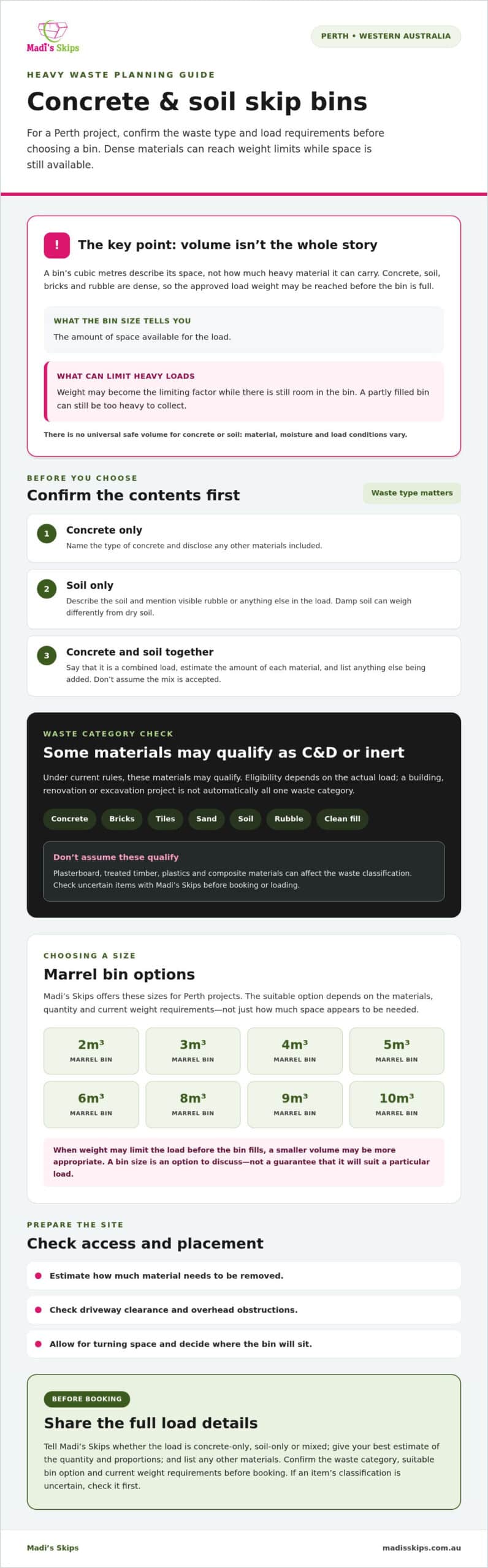
Concrete, bricks, tiles, sand, soil, rubble and clean fill may qualify as C&D or inert material under current rules. That doesn’t mean every building-site load is automatically eligible. A renovation bin, for example, might contain masonry alongside plasterboard, treated timber, plastics or composite materials. Check these rather than assuming they qualify.
Describe the materials plainly when you enquire. If you’re unsure about an item or its classification, confirm it with Madi’s Skips before booking or loading. A roll-off container, a general type of equipment used for skip-bin waste, can carry construction and demolition materials, but that doesn’t determine which waste category a particular load meets.
Can concrete and soil go in the same skip bin?
Possibly, but don’t assume a combined load is accepted. It depends on current waste rules and the load’s composition. Tell Madi’s Skips that you have both concrete and soil, give an approximate amount of each, and list any other materials, even if they seem minor.
- Concrete-only: List the type of concrete and disclose any other materials included.
- Soil-only: Describe the soil and mention any visible rubble or other contents.
- Combined load: State that it contains both concrete and soil, estimate their proportions, and identify anything else being added.
Clear details help Madi’s Skips confirm the right waste category before you book. If your load includes uncertain materials, get confirmation first rather than relying on the project name or a general C&D label.
Why concrete and soil weight matters more than bin volume
A skip bin’s size describes how much space it provides, not how much heavy material it can safely carry. Concrete, soil, bricks and rubble are dense, so the approved load weight may be reached while there’s still plenty of room in the bin. A partly filled bin can still be too heavy for its approved load.
That’s why volume alone isn’t enough to select a skip bin for concrete and soil Perth project. A light renovation clean-up and a smaller pile of concrete may occupy similar space but have very different weights. Material, moisture and load conditions all affect how much can go in. Don’t assume a partly filled bin is within requirements.
How much concrete or soil can a skip bin hold?
There’s no universal safe volume to use as a guide. Dry soil and damp soil can differ in weight, and concrete pieces vary in size and shape. A mixed load adds further uncertainty. Madi’s Skips offers Marrel bins in several sizes, but the right option depends on your specific material and its weight, not just the space it appears to occupy.
When you enquire, describe the project, the materials and your best estimate of the quantity. Ask Madi’s Skips which available bin may suit, and confirm the current load requirements. You can review Madi’s Skips bin sizes, but treat them as options to discuss, not a guarantee that a particular size will take your load.
When should you choose a smaller bin for heavy waste?
If weight is likely to limit the load before the bin fills, a smaller volume may be more appropriate than choosing a larger bin for extra space. For example, a compact concrete removal job may need a different approach from a larger excavation producing soil and other material. Neither the project size nor a bin’s cubic metre capacity confirms it’s suitable.
Give Madi’s Skips the details before settling on a size, especially if the soil may be damp or the load includes more than one material. The team can help clarify a suitable option against current requirements. Once you’ve confirmed the waste type and load details, you can book a skip bin online with a clearer understanding of what your project needs.
Concrete-only, soil-only or mixed waste: compare your Perth project
Booking details depend on what’s actually going into the bin. A concrete-only load, a soil-only load and a mixed excavation or renovation load shouldn’t be treated as interchangeable. Concrete, soil and clean fill may qualify as C&D or inert material under current rules, but the full load still needs to be described and classified correctly.
| Load type | What to list when enquiring | What to confirm |
|---|---|---|
| Concrete-only | Describe the concrete and disclose any other material, such as soil or rubble. | Whether the load qualifies for the relevant heavy waste or C&D category. |
| Soil-only | Identify the soil, estimate the amount and mention any visible concrete, rubble or other contents. | Whether the soil meets current requirements for the proposed waste category. |
| Mixed renovation or excavation waste | Name each material and provide an approximate breakdown, including any concrete and soil. | Whether the combined load is accepted and how it should be classified. |
What to book for a concrete-only or soil-only load
Start with the main material, then disclose anything else that will go in the bin. For example, don’t describe a load as concrete-only if you also plan to add soil or renovation debris. Concrete, soil and clean fill may be suitable for a heavy waste or C&D booking, subject to current rules. Confirm the waste category with Madi’s Skips before choosing a bin.
What changes when the load contains other building materials?
Mixed building waste doesn’t automatically qualify as C&D or inert material just because it comes from a construction or renovation project. Plasterboard, MDF, treated or processed timber, plastics and insulation need classification checks. Tell Madi’s Skips about them before booking rather than assuming they can be added to a concrete or soil load.
If separating materials is practical, ask whether separate loads are suitable under the booking requirements. Don’t split or combine waste based on a guess. Madi’s Skips’ available bin sizes can help you compare options, but volume isn’t the only consideration for dense materials. The right choice depends on the waste category, load composition and weight requirements.
Plan delivery, access and safe loading for heavy waste
Heavy waste needs planning before you book. First, confirm the waste category and describe every material. Then estimate how much you need removed, check the access route and placement area, and ask Madi’s Skips about the load requirements for your project. This helps you choose a suitable bin and prepare the site without assuming volume alone determines what can be loaded.
- Confirm the waste: List concrete, soil and any other materials separately.
- Estimate the quantity: Give Madi’s Skips a practical description of the amount, while recognising that weight may limit a dense load.
- Check access: Look at driveway clearance, overhead obstructions and turning space.
- Ask about loading: Confirm the applicable weight requirements and instructions before putting material in the bin.
Check the placement area before booking
Consider whether the bin can sit on your own property on a stable area, without blocking access or creating an obstruction for others. Check the route to the intended spot, including narrow driveways, gates and low branches or structures. If private-property placement isn’t possible and you’re considering a road, verge, footpath or other council-controlled area, check with the relevant local council first. Requirements can vary, so don’t assume one Perth-wide rule applies.
For a skip bin for concrete and soil Perth project, discuss the planned placement with Madi’s Skips when you enquire. Share access limits that could affect where the bin can be positioned. Confirming the details in advance helps set clear expectations, but don’t assume a particular placement or delivery arrangement until it has been discussed.
Load concrete and soil carefully
Follow the loading instructions Madi’s Skips confirms for your booking. Don’t overload the bin, heap material above its rim or exceed the agreed weight requirements. A bin can look partly empty and still be too heavy if it contains dense concrete or soil, so don’t use visible fill level as your only guide.
Keep to the waste type agreed at booking. If you plan to add another material or the load changes, check with Madi’s Skips before loading it. This is especially useful for excavation or renovation work where additional rubble, timber or other site waste may appear as the job progresses.
Book a Perth skip bin for concrete or soil with confidence
A clear booking starts with an accurate description of the load. For a skip bin for concrete and soil Perth project, share what you’re removing, how much you expect to have and where the bin needs to go. Confirm the waste category and suitable bin size with Madi’s Skips before completing your booking. Dense material can reach weight requirements before it fills the available space.
What details should you have ready?
Gather the key details first. Be specific about whether the load is concrete-only, soil-only or mixed, and mention any additional materials rather than grouping everything under a general project label. Your estimate doesn’t need to be exact, but it should give Madi’s Skips a useful picture of the job.
- Delivery suburb: The Perth suburb where you need the bin.
- Waste description: The main material and any other items in the load.
- Project quantity: A realistic estimate of the amount you plan to remove.
- Access and placement: Driveway clearance, overhead obstructions, turning space and the intended bin location.
Madi’s Skips offers Marrel bins in 2m³, 3m³, 4m³, 5m³, 6m³, 8m³, 9m³ and 10m³ sizes. These are options, not a guarantee that a particular size will suit every load. Consider the material type, then ask which bin is suitable under current waste and weight requirements.
When should you contact Madi’s Skips before booking?
Ask the team before booking if you’re unsure about a waste classification, want to combine concrete and soil, or plan to include unusual or additional materials. It’s also worth checking if the load is dense or its weight may be the limiting factor. A mixed load from an excavation or renovation can need a different assessment from a single-material load.
Once you’ve described the contents, quantity and access conditions, Madi’s Skips can help clarify the booking choice. If any detail is uncertain, check it first rather than relying on a guess.
Choose your bin with confidence
For a skip bin for concrete and soil Perth project, confirm the waste category before booking. Concrete-only, soil-only and mixed loads may have different requirements, so describe everything you plan to dispose of. Don’t judge suitability by volume alone: dense material can reach the applicable weight limit while the bin is still partly empty.
Estimate the amount you need removed and consider access and placement as well as capacity. Madi’s Skips offers Marrel skip bins in eight sizes: 2m³, 3m³, 4m³, 5m³, 6m³, 8m³, 9m³ and 10m³. The suitable option depends on your specific material and load, so check before choosing.
Locally owned and operated in Wattleup, Madi’s Skips services Perth and surrounding areas. If you’re unsure about a mixed load, waste classification or weight requirements, ask the team before completing your booking. Sharing clear details can help you make a more informed choice for your project.
With the waste type and bin option confirmed, you can move ahead with greater confidence.
Frequently Asked Questions
Is soil accepted in a skip bin in Perth?
Soil may be accepted, subject to the provider’s current waste requirements and the material’s classification. Tell Madi’s Skips whether the load is soil-only or includes concrete, rubble, clean fill or other materials. Soil can be heavy, particularly when damp, so the amount you can load may be limited by weight before the bin is full. Confirm the waste category and suitable bin before booking.
How much concrete can I put in a skip bin?
There isn’t a single safe volume that applies to every load. Concrete is dense, and a bin can reach its approved load weight while still partly empty. The suitable amount depends on the specific material, bin and current requirements. Before loading, describe your project and estimate the quantity for Madi’s Skips. Confirm the applicable weight requirements and follow the loading instructions for your booking.
What size skip bin do I need for concrete or soil?
Choose a size only after considering both the quantity and weight of the material. Madi’s Skips offers Marrel bins in 2m³, 3m³, 4m³, 5m³, 6m³, 8m³, 9m³ and 10m³ sizes, but no size guarantees acceptance of a particular load. Explain what you’re removing and how much, then ask which option suits the waste category and current weight requirements.
Can I put bricks, tiles or rubble in a concrete and soil skip bin?
Bricks, tiles and rubble may qualify as C&D or inert material under current rules, but don’t assume they can be added to every concrete or soil booking. Tell Madi’s Skips what materials are included and roughly how much of each. If the load also contains renovation waste, such as plasterboard or timber, disclose that too and confirm the correct category before loading.
Do I need council approval to place a skip bin on a verge in Perth?
Check with the relevant local council before placing a bin on a verge, road, footpath or other council-controlled land. Requirements can vary between Perth councils and depend on the placement area. Don’t assume rules for private property also apply to a public verge. If you can place the bin on your own property, consider that option and check that access and placement are suitable.
What happens if my skip bin contains mixed or unapproved waste?
Mixed or unapproved materials may affect how the load is classified and handled, and waste categories can have different disposal requirements and costs. Don’t assume materials can be added after booking or that a C&D label covers every building-site item. Describe the full load to Madi’s Skips before booking, and contact the team if its contents change or you’re unsure whether an item is accepted.
Disclaimer
The information provided in this article is general in nature and is intended as a guide only. While Madi’s Skips aims to provide accurate and up-to-date information, skip bin availability, pricing, service areas, waste classifications, disposal requirements, weight limits, surcharges and other conditions may change and can vary depending on the type and quantity of waste, bin size, delivery location and disposal facility requirements.
Information in this article should not override Madi’s Skips’ current Terms & Conditions, booking conditions or the information provided during the online quoting and booking process. Where there is any inconsistency, the current Terms & Conditions and booking information applicable at the time of hire take precedence.
Waste acceptance and classification can depend on the materials contained within a load. If you are unsure whether a particular material can be placed in a skip bin or which waste type you should select, please contact Madi’s Skips before booking or placing the material in the bin.
Any information relating to council permits, regulations or requirements is general guidance only. Requirements may vary between local government areas and can change over time. Customers are responsible for confirming any applicable requirements with their relevant local authority.
Madi’s Skips accepts no responsibility for loss, additional charges or other consequences arising from reliance solely on general information contained in our blog without confirming the requirements applicable to your individual booking.
