
A successful commercial de-fit is won or lost at the loading dock before the first desk is even dismantled. Booking a skip bin for office cleanout Perth operations often sounds simple on paper, but coordinating tight lease make-good deadlines alongside strict building management access rules can quickly trigger massive logistical headaches. You already have enough on your plate managing staff transitions and sorting through piles of broken workstations, worn-out chairs, and outdated paperwork.
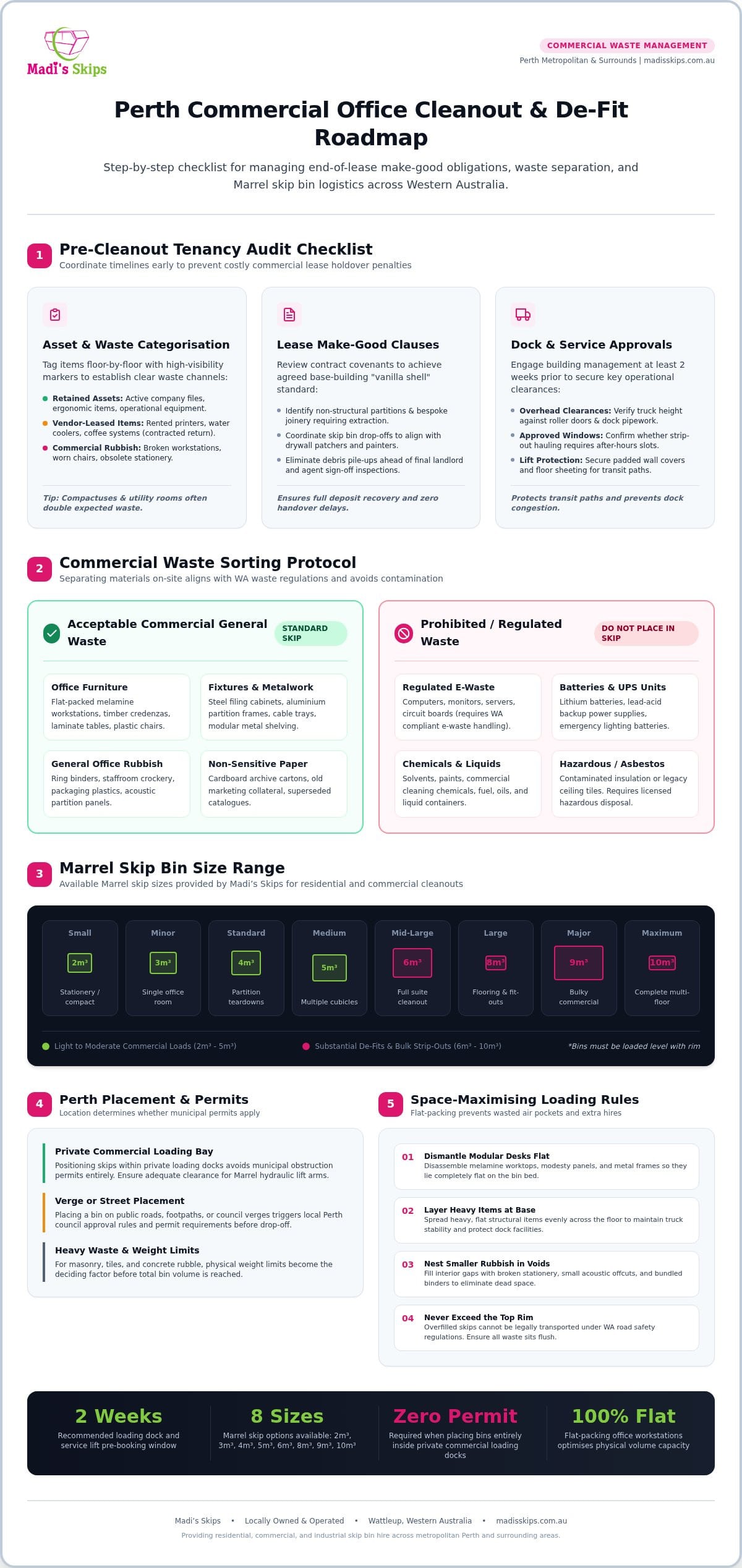
This practical checklist strips away the guesswork so you can streamline your commercial rubbish removal without disrupting ongoing business operations. You’ll learn how to accurately audit your bulky furniture volume, choose the ideal Marrel skip bin size from 2m³ up to 10m³, and keep your site fully compliant with local council guidelines and Western Australia’s e-waste disposal laws. From early dock clearance checks to final bin collection, here is your step-by-step roadmap to a smooth, cost-effective workplace cleanout.
Key Takeaways
- Align your cleanout timeline directly with commercial lease make-good clauses and conduct a room-by-room audit to separate reusable assets from rubbish.
- Choosing the right skip bin for office cleanout Perth jobs requires separating commercial general waste from banned items like regulated e-waste, batteries, and liquids.
- Selecting the correct Marrel bin size between 2m³ and 10m³ and flat-packing modular office furniture prevents wasted space and unnecessary extra bin hires.
- Positioning skip bins within private commercial loading bays avoids municipal obstruction permits, whereas verge or street placement triggers local Perth council approval rules.
- Layering heavy items flat across the base of the bin maximises usable capacity, protects dock facilities, and ensures safe, legal transport.
Perth Office Cleanout Planning: The Pre-Cleanout Audit Checklist
Executing an orderly office strip-out starts weeks before placing waste into a bin. In commercial tenancy handovers across Western Australia, failing to align your clearance milestones with end-of-lease dates leads straight to expensive holdover penalties. Assigning an internal office coordinator keeps departmental sorting disciplined and ensures personal effects stay separate from commercial waste streams.
Step 1: Conduct an Asset and Rubbish Inventory
Walk your tenancy floor by floor to categorise every physical item into retained company assets, community donations, or disposal. Standardise your tagging system using high-visibility stickers across storage archives, boardrooms, and staff breakout zones:
- Retained Assets: Active company files, ergonomic peripherals, and operational equipment transferring to your new premises.
- Vendor-Leased Items: Multi-function printers, rented coffee machines, and water coolers requiring contracted collection, not disposal.
- Commercial Rubbish: Chipped melamine workstations, broken office chairs, worn acoustic screens, and obsolete stationery supplies.
Audit utility rooms and kitchenettes thoroughly. Hidden rubbish accumulated in archive compactuses and storerooms often doubles your initial volume estimate.
Step 2: Review Tenancy Make-Good Lease Obligations
Examine your commercial lease clauses to pinpoint the exact condition your tenancy must achieve before final handover. Most Perth commercial leases enforce make-good clauses requiring spaces to be returned to base building condition, often referred to as a vanilla shell. Identify non-structural partition walls, bespoke joinery, and tenant-installed cabling that must be extracted.
Coordinate this work alongside trades patching drywalls or painting surfaces. Scheduling your delivery of a skip bin for office cleanout Perth operations to match these trade phases ensures fit-out debris clears off the floor immediately, avoiding bottlenecks during the final landlord inspection.
Step 3: Secure Building Approvals and Loading Bay Access
Commercial docks in central Perth and suburban office precincts demand strict operational timing. Reach out to building management at least two weeks before your planned cleanout to reserve dedicated slots for the loading bay and commercial service lift. This avoids operational clashes with regular couriers and neighbouring commercial tenants.
Heavy-duty Marrel trucks require adequate clearance to position industrial-grade skip bin containers securely. Check the physical constraints of your facility early:
- Overhead Clearances: Verify vehicle height limits, sprinkler pipes, and roller door clearances at basement dock entries.
- Approved Working Windows: Confirm whether strip-out hauling and noisy work must occur outside normal business hours.
- Lift Protection: Secure padded wall covers and floor sheeting for the service lift to avoid bond deductions from transit scuffs.
Locking in building access before booking ensures your cleanout proceeds smoothly on collection day.
Office Waste Sorting: What Can and Cannot Go in Your Commercial Skip
Commercial waste streams require careful sorting to avoid compliance issues at transfer stations. Unlike a standard domestic cleanout, office de-fits generate complex mixes of manufactured joinery, electrical components, and paper archives. Separating these materials on-site ensures your skip bin for office cleanout Perth project aligns with local recovery benchmarks outlined in Western Australia’s Waste Avoidance and Resource Recovery Strategy 2030.
Acceptable Office Waste for Skip Bins
Commercial general waste skips handle the vast bulk of non-hazardous dry fittings stripped from corporate workplaces. These include:
- Office Furniture: Flat-packed melamine workstations, timber credenzas, laminate tables, and plastic office chairs.
- Fixtures and Metalwork: Steel filing cabinets, aluminium partition frames, metal cable trays, and modular shelving.
- General Office Rubbish: Discarded ring binders, stationery, staffroom crockery, packaging plastics, and acoustic panels.
- Non-Sensitive Archives: Cardboard archive cartons, old marketing brochures, catalogues, and general non-confidential paper files.
Prohibited Items: What Must Stay Out of Your Bin
Strict environmental and transport laws bar hazardous substances from skip bins. Never toss unsealed liquids, cleaning chemicals, solvent tins, or wet paint into the bin. Asbestos sheeting occasionally discovered behind older tenancy tea rooms is strictly prohibited.
Specialised office hardware also presents unique hazards. Uninterruptible power supply (UPS) units, loose lithium-ion laptop batteries, and server backup cells create severe friction-fire risks in collection vehicles and cannot go into general skips. Commercial fluorescent lighting tubes contain mercury vapour and must go through dedicated commercial lighting recycling programs rather than general waste skips. Keep wet kitchen scraps and perishables out as well, directing them to regular council services instead.
Handling Office E-Waste and Sensitive Data Securely
Regulated electronic waste cannot be dumped into Perth landfills. Desktop computers, CRT or LCD monitors, server racks, and cabling must be segregated for authorised e-waste recyclers complying with AS 5377:2022. Diverting this bulky e-waste frees up significant space inside your Marrel bin for purely non-hazardous de-fit materials.
Financial records, employee files, and client documentation should undergo certified commercial document destruction before bin day. For specific advice on unusual commercial waste types or surchargable items like reception couches and fire extinguishers, contact our team directly before loading. Once you have sorted your office waste streams, you can book a bin online tailored specifically to your load.
Selecting the Best Skip Bin Size for Your Perth Office Cleanout
Getting bin capacity right prevents the unnecessary expense and delay of booking a second truck midway through your de-fit. Commercial cleanouts generate awkward, rigid waste that consumes volume quickly if loaded carelessly. Aligning your waste planning with Waste Authority WA guidelines means estimating your true cubic meterage realistically before your bin arrives on-site.
Small to Medium Cleanouts: 2m³ to 5m³ Skip Bins
For compact professional consultancies, medical rooms, or boutique agencies clearing out archive files and broken peripherals, a 2m³ or 3m³ Marrel skip offers ample room for boxed paperwork, obsolete stationery, and minor office clutter.
Upgrading to a 4m³ or 5m³ bin easily accommodates between five and ten fully disassembled workstations, along with ergonomic task chairs and under-desk mobile caddies. It represents the sweet spot for small suburban office tenancies and boutique retail shopfronts. Take time to check the exact dimensions across all available bin options before booking to ensure the container matches your layout.
Substantial Office Relocations and De-fits: 6m³ to 10m³ Skips
Full-floor cleanouts, departmental relocations, and complete tenancy handovers require substantial physical capacity. A 6m³ or 8m³ Marrel bin suits mid-sized corporate offices clearing out extensive storage rooms, customer lounges, and executive suites.
Select a 9m³ or 10m³ skip when stripping out multi-departmental corporate offices containing long boardroom tables, bulky acoustic booths, and dozens of partition screens. If your commercial de-fit includes knocking down structural masonry walls or lifting heavy floor screed, keep in mind that heavy construction rubble reaches road-transport weight limits long before the bin fills up physically. Madi’s Skips supplies heavy-duty Marrel bins specifically configured to handle these demanding commercial cleanout projects safely.
Volume Estimation Tactics for Office Managers
Don’t rely on generic household trailer-load formulas when coordinating a commercial de-fit. Office furniture behaves very differently to garden waste or home clutter:
- Measure the Footprint: Calculate the approximate cubic volume of bulky furniture by multiplying length, width, and height.
- Fill Dead Space: Avoid paying to transport trapped air. Pack open filing cabinets, credenzas, and hollow metal frames full of loose stationery and small rubbish before tipping them.
- Round Up When Divided: When balancing between two sizes for your skip bin for office cleanout Perth project, choosing the larger container prevents the disruption and cost of scheduling an emergency secondary haul.
Perth Site Logistics: Commercial Access, Placement, and Permits
Site logistics dictate how easily your waste moves from the tenancy floor to the road. Booking a skip bin for office cleanout Perth projects requires assessing the delivery pathway before the truck arrives. Factoring in property boundaries, overhead heights, and ground protection prevents property damage and unwanted council fines.
Private Property Placement vs Perth Council Verge Permits
Positioning your skip entirely within private commercial boundaries avoids local government approvals. If the bin rests inside your designated off-street loading dock, private rear car park, or internal tenancy compound, you don’t need a municipal permit. Building management or strata rules apply instead.
Setting a bin on a public street, verge, or pedestrian footpath triggers formal municipal review. In the City of Perth, occupying a public thoroughfare requires an Obstruction Permit with a standard assessment window of at least five business days. Surrounding metropolitan councils such as Subiaco, Vincent, and Stirling enforce their own specific road reserve policies, setback clearances, and verge rules. Customers must confirm permit requirements with their local council before placing bins on council land.
Navigating Commercial Driveways and Clearance Restrictions
Marrel skip trucks need adequate room to reverse, extend stabiliser legs, and hoist containers off the back. Look up along the delivery driveway for low-hanging tree branches, building overhangs, data cables, and fire sprinkler pipes. Commercial car park boom gates and tight radius corners can also block truck access.
Underground basement car parks present strict height limitations. Most Marrel trucks need substantial vertical clearance to raise their lifting arms safely. If your building features a subterranean dock with ceiling heights under 3.5 metres, position the bin in an open outdoor loading zone rather than underground. Placing timber battens beneath the bin’s steel corner castings also protects decorative paving and fresh asphalt from gouging under load.
Securing Your Skip in Publicly Accessible Commercial Precincts
Open commercial precincts often attract illegal night-time fly-tipping. Passing pedestrians and neighbouring shopfronts will quickly dump their rubbish into an unattended bin, taking up the space you paid for. Choose a drop-off spot visible to security cameras, position it under floodlights, or request a bin with secure tie-down covers to keep unauthorised waste out.
Review our local service areas across Perth to confirm delivery options for your commercial district.
Cleanout Execution Checklist: Efficient Loading and Final Handover
Loading your skip systematically makes the difference between a tidy, on-budget project and unexpected delays. Tossing assembled furniture into a container wastes cubic meterage and creates unstable voids. Staging your team’s labour around disciplined teardown processes ensures every cubic metre inside your skip bin for office cleanout Perth booking works at maximum efficiency.
Furniture Disassembly and Flat-Packing Protocol
Equip your cleanout team with battery-powered drills, impact drivers, and basic hand tools before clearing the floor. Tearing down modular desking on-site cuts the volume of office furniture dramatically:
- Strip Workstation Frames: Back out the fixing screws securing steel leg systems to desk returns, stacking the flat metal components together.
- Stack Melamine Panels: Lay laminate tops flat against one another along the base of the skip to create a solid, level foundation.
- Dismantle Screens: Unhook modular fabric partitions, acoustic baffles, and pinboards, laying them horizontally rather than leaning them diagonally.
- Utilise Metal Storage: Pull the sliding shelves out of metal tambour units and filing cabinets, packing loose stationery or lightweight plastic files inside the hollow carcases.
Safe Loading and Weight Distribution Guidelines
Pack the container methodically to maintain structural stability and keep road transport legal. Position heavy, flat panels across the floor first. Stack medium-weight items like broken office chairs and plastic bins in the middle, finishing with lighter archive boxes and cardboard towards the top.
Keep your load strictly level with the top edge of the bin walls. Under Western Australian road transport regulations, drivers cannot legally carry overloaded containers with debris protruding above the rim. Secure your transit corridors between the office and the loading dock using heavy-duty platform trolleys, ensuring team members practice safe two-person lifts on bulky steel credenzas.
Final Tenancy Inspection and Skip Collection
Once the last panel is loaded, carry out a thorough broom-clean sweep across all vacated suites, store cupboards, and tea preparation areas. Check common access paths and service lifts, wiping down any scuffs to protect your commercial bond.
Clear the loading dock area so the collection driver has unobstructed access during your booked window. Once your site audit is finished, book a skip bin online to lock in the right container for your cleanout schedule.
Take the Stress Out of Your Commercial Office Handover
Managing a commercial lease de-fit doesn’t have to overwhelm your team or compromise your security bond. By booking loading docks early, flat-packing desking systems, and separating general fit-out debris from regulated waste streams, you eliminate costly handover delays. Securing the ideal skip bin for office cleanout Perth operations keeps your tenancy clear, organised, and fully compliant with property standards.
Locally owned and operated in Wattleup, Western Australia, Madi’s Skips provides dependable delivery and collection across metropolitan Perth. With a sturdy fleet of Marrel skip bins ranging from 2m³ up to 10m³, we supply the exact capacity needed to handle bulky office furniture and commercial rubbish smoothly.
With an orderly plan and the right local container on site, handing back your tenancy keys on schedule is straightforward.
Frequently Asked Questions
Can I put office computers and old laptops directly into a skip bin in Perth?
No, you cannot place computers, laptops, monitors, or printers directly into a skip bin. Under Western Australia’s e-waste landfill ban regulations, disposing of regulated electronic waste in commercial general waste skips is illegal. Businesses must direct electronic equipment and IT assets to accredited e-waste recyclers complying with AS 5377:2022, preventing dangerous battery fires and hazardous heavy metals from entering local landfill facilities.
Do I need a council permit to place an office skip bin in metropolitan Perth?
You don’t need a municipal permit if the bin sits entirely within private commercial boundaries, such as an off-street loading dock or private car park. However, if your skip bin for office cleanout Perth project requires placement on a public street, metered bay, or verge, you must apply for local council approval. For example, the City of Perth enforces thoroughfare obstruction permits that require advance submission.
How far in advance should our business book a skip bin for an office cleanout?
We recommend booking your skip bin at least one to two weeks before your cleanout begins. While delivery is subject to vehicle availability, commercial tenancies require advance preparation. You need enough buffer time to confirm loading bay reservations with facility managers, organise lift protection with building caretakers, and ensure the delivery truck has unobstructed access during agreed service windows.
What is the most common skip bin size used for commercial office cleanouts?
The most popular sizes for commercial tenancies are 6m³, 8m³, and 10m³ Marrel skip bins. Mid-sized offices clearing out broken desking systems, storage cupboards, and reception furniture generally fill an 8m³ container comfortably once everything is flat-packed. For minor office moves or small corporate archive cleanouts, our 3m³ or 4m³ bins offer practical, cost-effective options.
Can we dispose of commercial carpet tiles and partitions in a general waste skip?
Yes, synthetic carpet tiles, acoustic fabric screens, and melamine partition panels are fully accepted in our commercial general waste skip bins. Under Western Australian waste classifications, these fit-out materials do not qualify as inert Construction & Demolition heavy waste. They must be booked under general commercial rubbish and dismantled flat across the bin floor to avoid wasting cubic space.
What happens if our office cleanout waste fills higher than the top rim of the skip?
Truck drivers cannot legally transport skip bins loaded above the top rim. Western Australian road transport safety laws strictly enforce level-load regulations to prevent loose debris from shifting or blowing off into traffic during transit. If your container is overloaded past the rim, you will need to remove the excess rubbish before collection, which can delay your commercial lease handover.
Are heavy office fireproof safes allowed inside standard commercial skip bins?
Heavy data safes and document vaults require prior consultation before placing them into a skip bin for office cleanout Perth cleanups. Safes contain dense steel framing and heavy concrete insulation that concentrate substantial weight into a tiny footprint. This can exceed legal road axle weights or Marrel hoist ratings, so always contact Madi’s Skips before attempting to load one.
Disclaimer
The information provided in this article is general in nature and is intended as a guide only. While Madi’s Skips aims to provide accurate and up-to-date information, skip bin availability, pricing, service areas, waste classifications, disposal requirements, weight limits, surcharges and other conditions may change and can vary depending on the type and quantity of waste, bin size, delivery location and disposal facility requirements.
Information in this article should not override Madi’s Skips’ current Terms & Conditions, booking conditions or the information provided during the online quoting and booking process. Where there is any inconsistency, the current Terms & Conditions and booking information applicable at the time of hire take precedence.
Waste acceptance and classification can depend on the materials contained within a load. If you are unsure whether a particular material can be placed in a skip bin or which waste type you should select, please contact Madi’s Skips before booking or placing the material in the bin.
Any information relating to council permits, regulations or requirements is general guidance only. Requirements may vary between local government areas and can change over time. Customers are responsible for confirming any applicable requirements with their relevant local authority.
Madi’s Skips accepts no responsibility for loss, additional charges or other consequences arising from reliance solely on general information contained in our blog without confirming the requirements applicable to your individual booking.
