
The biggest mistake people make during a clean-up isn’t underestimating their pile of rubbish; it’s ignoring the weight of the waste and their property’s physical access. When planning a weekend overhaul or a renovation, asking “what size skip bin do I need” usually comes with twin worries: paying for empty airspace in an oversized bin, or hiring one that is too small and paying for an expensive second delivery.
Trying to translate cubic metres into real-world piles of timber, soil, or old furniture is confusing. In this guide, you will discover how to match your exact project volume, waste materials, and Perth property access to the perfect bin size without blowing your budget. We break down practical visual equivalents like standard 6×4 box trailers and wheelie bins, cover vital weight restrictions for heavy materials, and outline local Perth council verge rules so you can book the right capacity the first time.
Key Takeaways
- Visualise capacity easily by matching Marrel skip bins (from 2m³ to 10m³) against standard 6×4 box trailers to stop second-guessing what size skip bin do I need.
- Separate heavy materials like concrete, sand, and soil early, as weight limits can cap your bin capacity long before physical space runs out.
- Check your driveway dimensions and local Perth council verge permit requirements before booking to avoid unexpected placement fines or delivery delays.
- Pack your skip strategically by breaking down furniture, loading flat items first, and keeping waste strictly level with the rim to ensure safe transport.
Understanding Skip Bin Sizes: Visualising Cubic Metre Volume
Working out skip capacity starts with a simple measurement. One cubic metre (1m³) is an area one metre long, one metre wide, and one metre high. While that metric makes sense on paper, imagining how your household rubbish fits into that space is tricky. When Perth property owners ask us, “what size skip bin do I need?”, we translate raw measurements into real-world benchmarks you see every day.
Understanding cubic metre volume prevents the headache of running out of room halfway through a clean-up. Packing technique also dramatically changes how much you can fit. Busting apart timber frames, flat-packing cardboard boxes, and dismantling old furniture removes empty voids. Selecting the correct size from the start keeps you from hiring two separate bins, which always costs more than ordering the right capacity initially.
The 6×4 Box Trailer Rule of Thumb
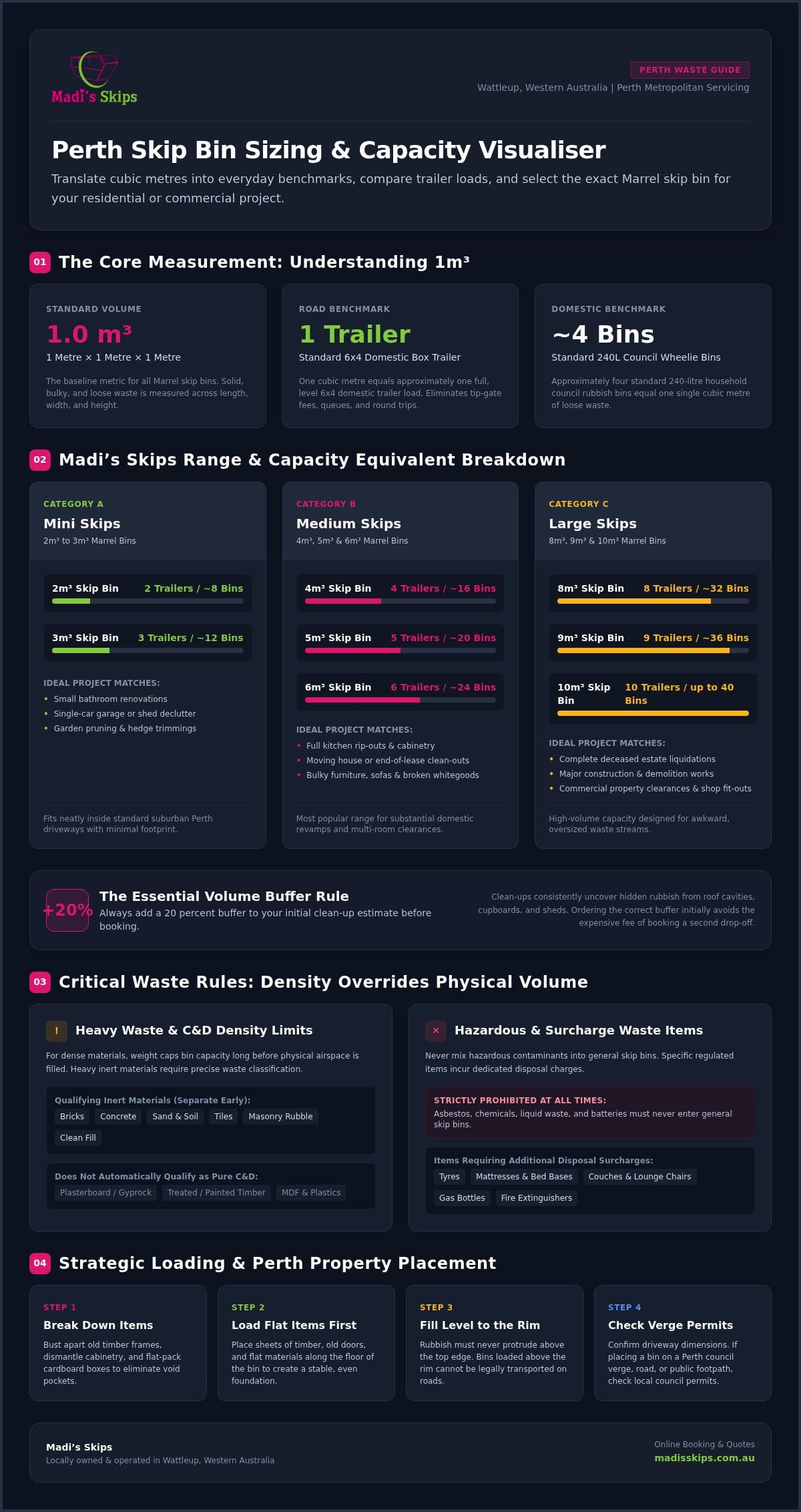
The easiest visual comparison is a standard 6×4 domestic box trailer filled level to the top edge. As a practical rule of thumb, one cubic metre equals roughly one level trailer load. If you hire a medium 4m³ Marrel skip, you are effectively hiring four trailer loads of capacity delivered straight to your property.
Using a skip eliminates four tiring round trips to local transfer stations. You cut out trailer hook-ups, multiple tip-gate fees, fuel costs, and hours lost waiting in weekend landfill queues. Everything goes into one secure bin placed right beside your work area.
Visualising Common Marrel Skip Bin Capacities
Another reliable benchmark is the standard 240-litre residential wheelie bin. About four full council wheelie bins equal one cubic metre of loose rubbish. Madi’s Skips supplies heavy-duty Marrel bins in eight specific sizes across Perth to match any clean-up scale:
- Mini Skips (2m³ to 3m³): Equal to 2 to 3 trailer loads, or roughly 8 to 12 wheelie bins. These compact bins suit small bathroom renovations, shed declutters, and general garden tidy-ups.
- Medium Skips (4m³, 5m³, and 6m³): Equal to 4 to 6 trailer loads, or roughly 16 to 24 wheelie bins. These work best for full kitchen rip-outs, multi-room domestic clean-outs, and moving house.
- Large Skips (8m³, 9m³, and 10m³): Equal to 8 to 10 trailer loads, holding up to 40 wheelie bins of waste. Perfect for complete property clearances, major construction work, and shop fit-outs.
Still wondering what size skip bin do I need for your upcoming job? You can read more about skip bin hire Perth operations to see how our trucks handle tight residential placements and suburban access.
Matching Your Project to the Right Skip Bin Size
Every clean-up project generates more rubbish than expected once the work begins. Deciding what size skip bin do I need starts with assessing both your timeline and the exact types of materials you are discarding. Sorting your waste into clear streams, like bulky domestic furniture, green garden waste, and mixed light rubbish, helps you gauge the volume before booking. Always add a 20 percent buffer to your initial estimate. That extra allowance absorbs the unforeseen junk pulled from cupboards, roof cavities, and sheds without requiring a second drop-off.
Whether handling a backyard overhaul or following guidelines for safely managing construction waste during a home build, matching your job scope to bin capacity prevents unnecessary costs. For a detailed breakdown of how different rubbish skip sizes compare against common Perth project types, our ultimate guide turns cubic metre measurements into practical, real-world examples.
Small Bins (2m³ to 3m³) for Minor Clean-ups and Garden Pruning
These compact skips suit small domestic projects with limited space. If you are clearing out a single-car garage, tackling an overgrown courtyard, or pruning small trees, a 2m³ or 3m³ Marrel bin provides plenty of room. They hold light garden waste, including hedge clippings, small branches, and discarded potting mixes. Check the dimensions of our available bins to confirm that a mini skip will fit neatly inside your driveway or front boundary.
Medium Bins (4m³ to 6m³) for Kitchens, Bathrooms, and Moving House
Mid-sized bins handle substantial residential revamps and major lifestyle transitions. When gutting an outdated bathroom, ripping out laminate kitchen cupboards, or pulling up old carpet, a 4m³, 5m³, or 6m³ bin delivers the right depth. These sizes comfortably swallow bulky items like sofas, broken whitegoods, timber cabinetry, and boxed general rubbish. If you are preparing a Perth property for sale or end-of-lease inspection, this middle tier covers the clean-out easily.
Large Bins (8m³ to 10m³) for Building Works, Deceased Estates, and Commercial Strips
Substantial clean-outs demand serious volume. Complete deceased estate liquidations, whole-house strip-outs, and commercial shop refits generate awkward, oversized waste that rapidly overfills standard skips. An 8m³, 9m³, or 10m³ Marrel bin accommodates long framing timbers, modular office partitions, cabinetry carcases, and large commercial packaging without demanding endless disassembly. If you are coordinating commercial work or site clearances, we recommend planning your layout early.
Before you commit to a capacity, take a quick inventory of your largest planned items. If you are still weighing up dimensions or want to check local drop-off dates, you can secure your delivery directly when you book a bin online with our team.
Weight Restrictions and Heavy Waste: When Density Overrides Volume
Calculating bin capacity by physical space alone can land you in trouble when dealing with structural or ground materials. When asking what size skip bin do I need for landscaping or demolition, material density matters just as much as volume. Dense loads like clean fill, garden turf, soil, sand, and clay add up quickly. Every Marrel truck operating across Perth must strictly comply with legal gross vehicle mass ratings and axle weight limits on Western Australian roads. Overloaded skips present serious transit hazards, risk damaging residential driveways, and can exceed the truck’s hydraulic lifting capacity.
Why Heavy Soil, Concrete, and Bricks Require Smaller Bins
A single cubic metre of broken concrete, limestone rubble, or damp soil weighs upwards of 1.5 tonnes. If you were to fill an 8m³ or 10m³ bin with crushed pavers or excavated dirt, the total weight could easily exceed 12 to 15 tonnes. A skip that heavy simply cannot be lifted safely by standard Marrel lifting arms, leaving it stuck on your property until the excess is hand-shovelled out.
For concentrated heavy projects like lifting driveways, digging footings, or clearing brick walls, we recommend choosing 2m³, 3m³, or 4m³ skips. Using smaller capacities guarantees the bin remains within safe lifting limits and road transport safety laws.
Understanding Mixed Waste versus Construction and Demolition Rubble
Disposal facilities apply separate processing streams for clean Construction and Demolition (C&D) inert material compared to general household waste. Qualifying C&D materials include:
- Clay bricks and concrete pavers
- Clean ceramic tiles and porcelain fixtures
- Hardened concrete footings and slabs
- Clean fill, limestone, and site rubble
Tossing general building rubbish into a heavy waste bin changes how that load must be processed. Common renovation items such as gyprock plasterboard, treated pine, MDF cabinets, plastics, and roof insulation do not qualify as inert C&D waste. When mixed materials are unavoidable, your bin must be booked as general or mixed waste. Understanding how waste classification affects skip bin prices Perth customers receive can help you avoid unexpected charges when your debris falls across multiple categories. If you are unsure which category your debris falls under, contact our team before ordering to ensure you select the right bin type for the job.
Perth Placement, Property Access, and Council Regulations
Physical site access dictates what size skip bin do I need just as much as waste volume. Even if a 10m³ skip matches your rubbish pile, tight suburban streetscapes, narrow gates, and low overhead obstacles might make a smaller footprint necessary. Assessing where the bin will sit ensures a smooth delivery on drop-off day.
Driveway Clearance and Marrel Truck Delivery Requirements
Madi’s Skips uses specialised Marrel trucks that reverse into position and swing bins off the rear chassis using hydraulic boom arms. This mechanical setup requires a straight reversing line and adequate operational room:
- Driveway Width: Delivery trucks require a minimum clearance width of approximately three metres to navigate gates, fences, and tight crossovers.
- Overhead Obstacles: Boom arms raise high to lower the skip onto the ground. The placement area must remain clear of powerlines, overhanging tree branches, low building eaves, and solar panels.
- Surface Protection: Heavy steel bins can scratch or gouge sensitive decorative surfaces. If you want the skip placed on liquid limestone, exposed aggregate, or brick paving, lay thick timber boards down first to absorb point pressure and safeguard your driveway.
Council Verge Permits Across Perth Metropolitan Suburbs
When driveway space is limited, the street verge is the next practical option. In Western Australia, placing a skip bin on private property never requires a permit, but council-controlled land is a different matter. Perth is split across more than thirty local government areas, and verge placement rules vary considerably from one municipality to the next.
For example, the City of Cockburn requires permits for verge placement and limits bin sizes to 8m³, while the City of Fremantle and City of Melville often mandate formal obstruction permits and refundable verge bonds for building-related projects. Failing to obtain required council approval can result in unexpected compliance fines. Check individual municipal regulations before scheduling street-side delivery, or read more about skip bin hire Perth placement procedures to ensure smooth access.
Evaluating site access early stops you second-guessing what size skip bin do I need when our truck arrives on your street.
Smart Loading Strategies and Booking Your Perth Skip Bin
How you load your skip bin affects how much usable volume you actually get. Tossing bulky items into a bin haphazardly creates hollow air pockets, wasting valuable capacity and leading you to wonder whether you under-ordered. Knowing how to pack efficiently helps resolve the question of what size skip bin do I need, letting you extract every bit of value from your chosen capacity.
How to Pack a Skip Bin to Maximise Usable Volume
Strategic packing follows a logical bottom-up approach to eliminate voids:
- Lay flat items first: Place flat materials like timber panels, broken doors, sheet metal, and collapsed cardboard flat against the floor of the bin.
- Distribute dense weight evenly: Stack bricks, pavers, and heavier pieces over the base layer, keeping the centre of gravity low and stable for transport.
- Fill hollow pockets: Hollow items like buckets, crates, or dismantled drawers should be packed full of smaller offcuts, garden trimmings, or loose debris.
- Dismantle furniture: Unscrew table legs, smash apart old bed frames, and cut tree branches into short lengths rather than throwing them in whole.
Always observe the water-level fill rule. Skips cannot be loaded past the top rim of the bin walls. In Western Australia, drivers face heavy fines for transporting overfilled loads that risk shedding debris on suburban roads or freeways. If waste sits above the top rail, drivers cannot legally fit the transport tarp or remove the skip from your property.
Prohibited Items and Surcharge Materials to Exclude
Strict state safety and environmental regulations prohibit certain items from general skip bins. Hazardous materials must never be placed inside, including asbestos, wet paints, liquid chemicals, vehicle batteries, flammable oils, and poisons. These dangerous items must be taken to specialised local Household Hazardous Waste drop-off facilities instead.
Certain domestic goods require specialist processing at registered transfer stations and carry individual surcharges. If your project includes mattresses, ensemble bases, tyres, gas bottles, or fire extinguishers, declare them before booking so disposal can be managed correctly.
Once you assess your rubbish volume, confirm site clearance, and review material types, locking in your delivery is fast and straightforward. Head directly to book a bin to select your dates and secure your Perth delivery.
Lock In the Right Bin for Your Perth Clean-Up
Getting the right skip comes down to balancing your rubbish volume against material density and property access. Heavy masonry and soil demand smaller capacities to stay within road safety limits, while mixed domestic clean-outs always benefit from a slight buffer. Rather than stressing over what size skip bin do I need halfway through your project, visualising your waste in trailer loads and packing flat items first ensures you won’t pay for empty space or an unexpected second drop-off.
Locally owned and operated in Wattleup, Madi’s Skips supplies durable Marrel bins ranging from 2m³ to 10m³ across the Perth metropolitan area. Our transparent booking system and practical waste advice help you sort out your site without fuss or delays. Before you finalise your booking, reviewing what factors shape skip bin prices Perth quotes are based on ensures you can compare options accurately and avoid any surprise charges.
Frequently Asked Questions
What is the most popular skip bin size for household clean-ups in Perth?
The 4m³ and 6m³ skip bins are the most popular choices for suburban households across Perth. Holding the equivalent of 4 to 6 standard trailer loads, these mid-sized options easily handle garage clear-outs, light landscaping, and kitchen or bathroom updates. When customers ask what size skip bin do I need for an annual clean-out, a 4m³ or 6m³ bin gives the right balance between volume and driveway space.
How do I know if my waste is too heavy for a large skip bin?
Your waste is classified as heavy if it consists primarily of excavated earth, sand, broken concrete, clay bricks, or paving stones. Because a single cubic metre of dense masonry weighs roughly 1.5 tonnes, loading an 8m³ or 10m³ skip with rubble will exceed legal axle limits and truck lifting capacities. For heavy, compact materials, stick to smaller 2m³, 3m³, or 4m³ bins to ensure safe transport.
Can I place a skip bin on the council verge outside my Perth property?
Placing a skip bin on a council-owned verge or road reserve generally requires a permit from your local municipal council. While private driveways need no approval, regulations vary widely across Perth’s local government areas. Some councils enforce bin size restrictions, while others require formal obstruction applications and refundable bonds. Always check your specific council’s guidelines before arranging delivery onto public land.
What happens if I accidentally overfill my skip bin above the rim?
Drivers cannot legally transport a skip bin loaded past the top edge of the walls. Western Australian road transport laws mandate that all skips must be securely tarped to prevent flying debris on roads and freeways. If a bin is piled above the rim, our driver cannot safely cover the load, and you will be asked to remove the excess materials before pickup.
What materials are strictly prohibited from being put in a skip bin?
Hazardous, toxic, and flammable materials are strictly prohibited from general skip bins under state environmental laws. You cannot place asbestos, liquid paints, wet chemicals, oils, poisons, vehicle batteries, or gas cylinders into our bins. These items pose serious safety risks and must be taken to registered municipal Household Hazardous Waste drop-off facilities across Perth for proper disposal.
How much driveway clearance does a Marrel delivery truck require?
Marrel delivery trucks require a minimum clearance width of approximately three metres to safely navigate domestic driveways and side gates. In addition to ground width, the drop-off location needs adequate overhead space for hydraulic boom arms to lift and lower the bin. Check that entryways are clear of low tree branches, roof eaves, utility wires, and carports before delivery.
Can I put mattresses and tyres into a general waste skip bin?
Mattresses, bed bases, and tyres can be collected in a skip, but they must be declared when you place your booking. Local waste processing facilities treat these items separately from standard mixed rubbish, which means individual disposal surcharges apply. Factoring bulky items into your project helps answer what size skip bin do I need while avoiding unexpected fees on pickup.
Disclaimer
The information provided in this article is general in nature and is intended as a guide only. While Madi’s Skips aims to provide accurate and up-to-date information, skip bin availability, pricing, service areas, waste classifications, disposal requirements, weight limits, surcharges and other conditions may change and can vary depending on the type and quantity of waste, bin size, delivery location and disposal facility requirements.
Information in this article should not override Madi’s Skips’ current Terms & Conditions, booking conditions or the information provided during the online quoting and booking process. Where there is any inconsistency, the current Terms & Conditions and booking information applicable at the time of hire take precedence.
Waste acceptance and classification can depend on the materials contained within a load. If you are unsure whether a particular material can be placed in a skip bin or which waste type you should select, please contact Madi’s Skips before booking or placing the material in the bin.
Any information relating to council permits, regulations or requirements is general guidance only. Requirements may vary between local government areas and can change over time. Customers are responsible for confirming any applicable requirements with their relevant local authority.
Madi’s Skips accepts no responsibility for loss, additional charges or other consequences arising from reliance solely on general information contained in our blog without confirming the requirements applicable to your individual booking.
